
In Praise of Crucible Experiences
There is a peculiar and unique tradition at Duke University, where students have to camp out outside the basketball stadium for several weeks in order to prove their allegiance to the Duke basketball team to get a ticket for the Duke-UNC basketball game, that happens once a year. This is a test of worthiness for the privilege to sit in the student section - which cannot be given to just any student.
These tickets cannot be bought or sold, and the university clearly leaves a lot of money on the table, considering how in-demand these tickets are, and how storied Duke is as a basketball institution. The ticket allocation does not happen via lottery or any other means, but through this over-the-top, student-administered ritual, complete with its own exam about Duke basketball trivia, a special constitution, enforcement authority, and even hazing rituals - such as teams of students not being able to all leave their tents even for some time, no matter if overnight or for class, for fear of forfeiting their position in line and missing the all-important game.
All in all, just a fascinating example of college culture, and the way Russ Roberts and Michael Munger analyzed it on the EconTalk podcast was a lesson in economics as well: prices paid and markets beyond just ones that involve exchanges of money.
This whole analysis and phenomenon is fascinating, but what I took from the conversation was that students rated this experience extremely highly, despite the inefficiencies and discomfort it involved. Students voluntarily went through this discomfort, and came out on the other side with amazing memories, and even higher average grades and starting jobs than those who did not partake in this experience. Better bonds and friendships were formed, and I’d assume (but I’m not sure whether it has been confirmed or can be studied for causation) that students going through this might be better positioned for the challenges in life.
The hosts likened it to training with the marines, for example: something so hard, but so transformative that it leads to overall character hardening. The non-monetary costs paid seem to be more important to the benefits received than what money can buy.
It seems like voluntary, high-stakes, time-bounded collective ordeals - what I term as “crucible experiences” - create unusually durable bonds, identity, competence, and meaning, and those benefits are often undervalued relative to the obvious inefficiency, discomfort, or irrationality of the ritual itself.
In a world increasingly obsessed with efficiency, optimization, and measurable ROI, we may be neglecting the social technologies that actually build people. These crucible experiences forge unusually deep friendship, trust, and collective identity not just because people go through something hard together, but because they emerge with a shared narrative: a lasting story about who they were, what they built or endured, and what that says about them.
That narrative then compounds into confidence, agency, resilience, earned pride, practical leadership and judgment, and even a durable sense of institutional loyalty and belonging.
My personal experience with something similar was at IIT Bombay, which to its credit has so many such crucible moments baked into its famed campus culture. It’s no wonder that it leads to an amazing set of benefits later in life, both personal and professional.
Starting with the Performing Arts Festival or PAF, where an end-to-end theatrical production is set up by students, from scratch, over the period of a couple of months - culminating in a 3-4 day/night sprint to use bamboo, papier mache, and duct tape to set up these elaborate sets. Late nights, hazing, and camaraderie all forged in the meantime, culminating in an amphitheater experience of joy - there is nothing quite like it.
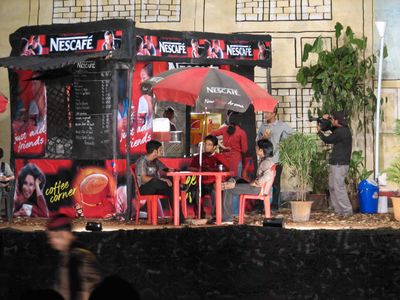
Then there is the famed Mood Indigo and Techfest college festivals, inviting participation from all over the country, featuring performances from artists all over the world. During my four years on campus, I was treated to an embarrassment of riches when it came to musical artists at Mood Indigo - a privilege that did not sink in until years later. However, beyond this lived experience, it is the ritual and process of organizing these festivals that is so unique - months of planning, self-organizing into teams, and an experience akin to running a small startup over late nights and weekends - that was invaluable.
Some of my closest friendships and fondest memories that endure to this day come from these experiences we had together organizing. Some students made it a big part of their identity, and even leveraged their experience into jobs that rewarded the hustle, execution, and problem-solving that these ambiguous, unstructured environments forged.
Experiences like these go far beyond ones from intense studying for hard courses or degrees, or partying or traveling together that happens in most college experiences. Living together in dorms comes close, but that benefit accrues more toward the relationships side of the house, and does not have the associated character benefits. Some other college experiences - like traveling as a contingent to an inter-college sports meet or cultural meet - may lead to similar bonding.
I can contrast this to grad school, where something similar did not happen, at least for me. Grad school was a collection of interesting and hard classes, homework, projects (which seemed interesting, but small and low stakes), exams (such as the dreaded qualifiers), and social events, but nothing comparable to the crucible experiences above. And that is why grad school was inherently less memorable, despite it being in a different country on an expansive campus.
One would think that going through an experience such as a startup, or an intense work setup, may lead to similar benefits and relationships. However, by nature, work stays at work, there is turnover and misaligned incentives, and so the downstream impacts may not be as profound. For me, at least, work relationships have not persisted beyond work. Traveling is too consumptive and, unless it involves something off the beaten path and some problem-solving, seems shallow.
To the extent that these experiences can be replicated or opted into, they should, because the benefits are substantial and durable.
With the advances in AI, I have been first to admit that the academic credential of college would no longer be worth it. But listening to this conversation made me change my perspective a little: even if not academically, the right college with these formative experiences baked in can lead to downstream benefits that don’t always get accounted for in any analysis.
Everyone talks about alumni networks, especially forged through experiences like business school, and those benefits, while true, do not come close to the social benefits from crucible experiences. I’d certainly look for these in the culture, as I think about school and college as a parent.
Beyond just parents finding these experiences for their kids, it is worth pondering how one could sustain these effects in other things we do. Since relationships are the most reliable predictor of health as well as fulfillment later in life, it is worth investing for that benefit alone.
Once out of college, you have to rely on “manufactured” opportunities. Something like music festivals, Tough Mudder and other endurance and adventure sports, or even Burning Man, fill in the void that some of us crave. While some of these are industries and feel manufactured, they seem to be a response to a core human need.
As you get older and have pressures on your time from kids, parents, and work, these crucible moments become rarer and rarer to find and nurture. The challenge seems to be designing these experiences so they feel authentic and provide similar benefits. I’d think creative pursuits - like being part of a movie production, or something like a political campaign - intense, time-bound, and mission-driven - may lead to similar effects.
What these experiences leave behind is not just nostalgia, or even friendship, but a durable shared narrative: a sense of having belonged to something demanding, improbable, and larger than oneself.
In an age that increasingly prizes convenience, legibility, and efficiency, it is easy to dismiss such rituals as irrational or wasteful. But that may be precisely backwards. Some institutions are valuable not despite the friction they impose, but because of it.
That is worth remembering when we judge schools, communities, and even our own commitments: the most formative experiences are often not the ones that deliver the cleanest resume line or the least inconvenience, but the ones that ask for shared effort and leave behind a story people keep re-living inside.